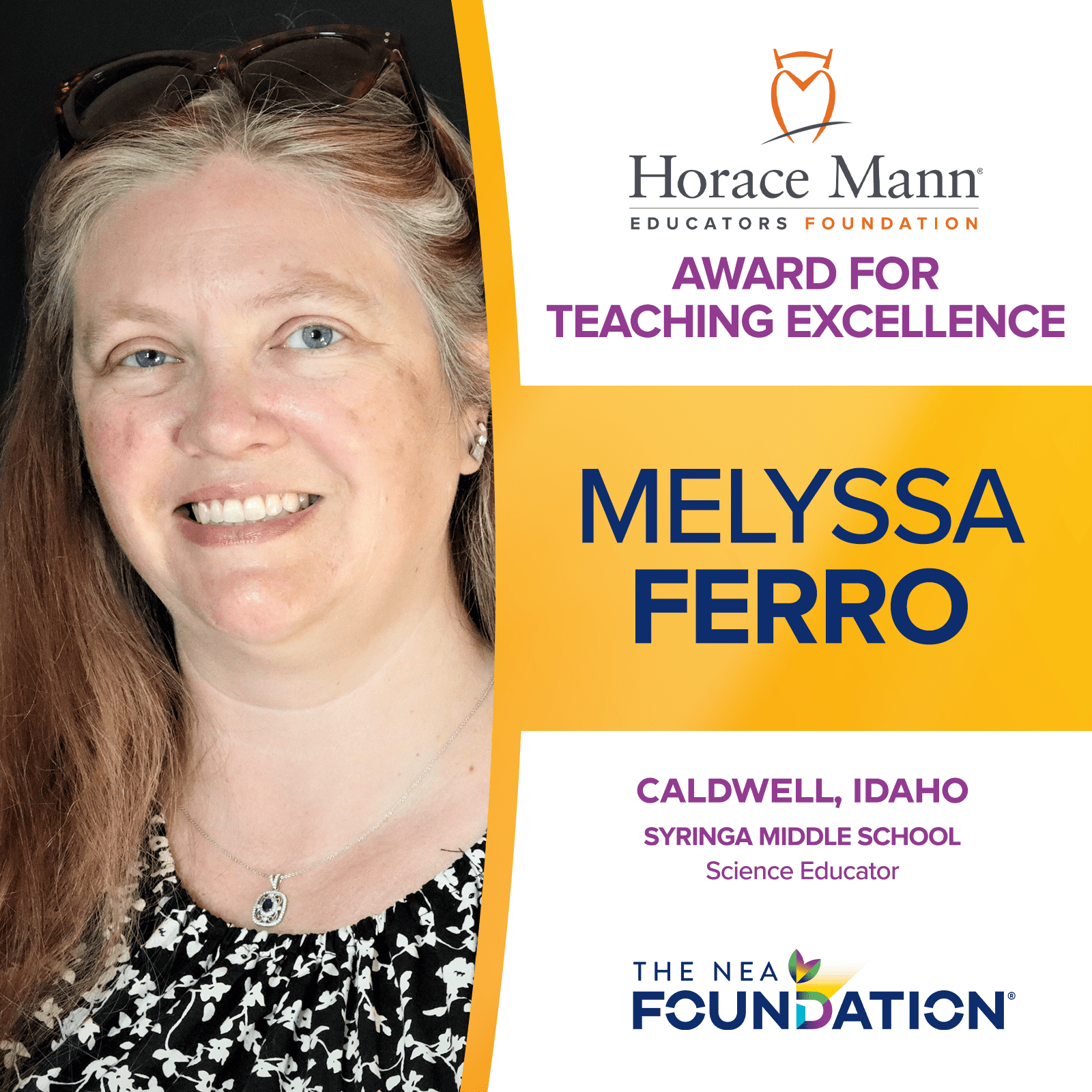
Melyssa Ferro is a 6th-8th grade science educator at Syringa Middle School in Caldwell, ID. She is also one of the five educators receiving the 2026 Horace Mann Awards for Teaching Excellence.
Introduction
In Idaho, water isn’t something we can take for granted. From the snowpack in the mountains to the irrigation systems that sustain our farms, water determines whether communities thrive or struggle. Just as every drop of water shapes the health of our ecosystems, every partnership and local connection shapes the flow of opportunity for my students. There is no better way to ponder the connection between an Idaho mountain snowpack and sustainable agricultural practices than eating a juicy slice of watermelon during your first-period science class. My students gleefully munch their locally grown snack while taking notes about the historical importance of using certain crops to store water and reclaim nutrients from the soil. Ms. Josie, a local farmer, has come to visit our classroom in preparation for the Future City Engineering competition. Her knowledge of regenerative farming will help my students better understand how to design a futuristic city that can provide food for all of its citizens. These moments are like the first drops of water in a watershed; small but essential contributions that eventually flow together to nourish something much bigger. Over the years, I have learned that partnerships like this one are not an ‘extra’. They are the lifeblood of authentic, equitable STEM learning. Every partnership adds a new stream to the watershed of opportunity, carrying my students further than I ever could alone.
The Need
Too often, classrooms across the country, especially in under-resourced communities, are left in a drought of interactive learning where class time is mostly spent on worksheets and testing drills. Partnerships are how I’ve kept my classroom out of that drought. When national pressures push schools toward rote learning, partnerships bring the living water of authentic science back to my students. National data suggests fewer students today experience inquiry-based instruction than before, which makes our partnerships even more critical. If we want students to thrive, we must ensure they have access to the living waters of problem-based, place-based, and project-based learning. These are the tributaries that flow into the larger watershed of equity, giving every child the chance to see themselves as scientifically capable.
The Power of Place-Based Partnerships
“Where you are is who you are.” This phrase circulates widely, but in the context of science education it becomes deeply profound. As a teacher, I act as the confluence point where all these tributaries meet. Bringing together wildlife biologists, farmers, and engineers allows their expertise to flow into my classroom. Whether it’s a trip to our local wildlife refuge to study how community choices affect watershed health, or a visit from local engineers to guide our Future City project, grounding science in our own community keeps the river of learning alive and moving. Each partnership is a tributary which adds new perspectives, resources, and energy to the current of our curriculum. These connections not only contextualize concepts but also give my students a powerful sense of agency and responsibility. And when community partners step into our classroom, they help legitimize the content, putting a human face on the science and showing students that these ideas matter beyond the textbook.
Equity and Student Impact
For too long, traditional science curriculum has left many students standing on the banks, watching others do science rather than seeing themselves in the flow of discovery. When I conducted research for my doctoral dissertation, I found that young women and students of color often described science as something that happened “out there,” not something they could imagine themselves doing. Place-based, hands-on experiences invite these students into the current, giving them opportunities to build scientific self-efficacy and identity. One of my former students, now at Stanford, exemplifies this transformation. He proudly describes himself as a first-generation Mexican American, passionate about earth and ocean science, space exploration, and government. He has shared publicly that his love of science began in my classroom, where local, place-based projects helped him step into the flow of science for the first time. Today, as he works toward his dream of earning a doctorate, I am reminded that the waters we introduce our students to may one day carry them into futures far beyond what they imagined.
The Role of Educators and Unions
Educators are like watershed stewards. We safeguard the flow of opportunities, ensuring that every student has access to authentic learning experiences. Allowing students to “touch grass” in their ecosystems doesn’t just enrich instruction; it cultivates the kinds of critical thinkers and problem-solvers our planet needs. But partnerships require time, funding, and trust to grow. That’s where my union and organizations like the NEA Foundation come in. They help me remove barriers so I can focus on building those community connections that matter most. When educators and unions work together, we expand the watershed of opportunity for every learner.
Conclusion
You don’t need a perfect plan to begin, just the courage to make one call or send one email. Each small step can create a new tributary in your watershed of opportunity. Science is everywhere in your community, waiting to be tapped as a living curriculum, and the partnerships you build can carry your students further than you ever imagined. A watershed is defined as the land drained by a particular body of water, but in education it becomes a metaphor for equity: every drop, every stream, every partnership flowing together to shape our students’ futures. These partnerships aren’t just shaping my students’ futures, they’re shaping a future for all of us. In a time when the value of science and even the concept of facts are openly questioned, giving students authentic ways to see themselves as scientists is one of the best ways to ensure that the river of knowledge continues to flow. By grounding science in our communities, we’re not only equipping the next generation of problem-solvers, but also safeguarding the future of informed, evidence-based decision-making for us all.
THE NEA FOUNDATION IS COMMITTED TO FEATURING DIVERSE VOICES AND PERSPECTIVES ABOUT CRITICAL ISSUES FACING PUBLIC EDUCATION, STUDENTS, AND EDUCATORS. THESE VIEWS DO NOT NECESSARILY REFLECT THOSE OF THE NEA FOUNDATION.